Start with the price you will actually pay
AI-generated generic editorial illustration — not a retailer product photo and does not depict the reviewed product or service. Make the total-price check immediately scannable before readers assess a promotion.
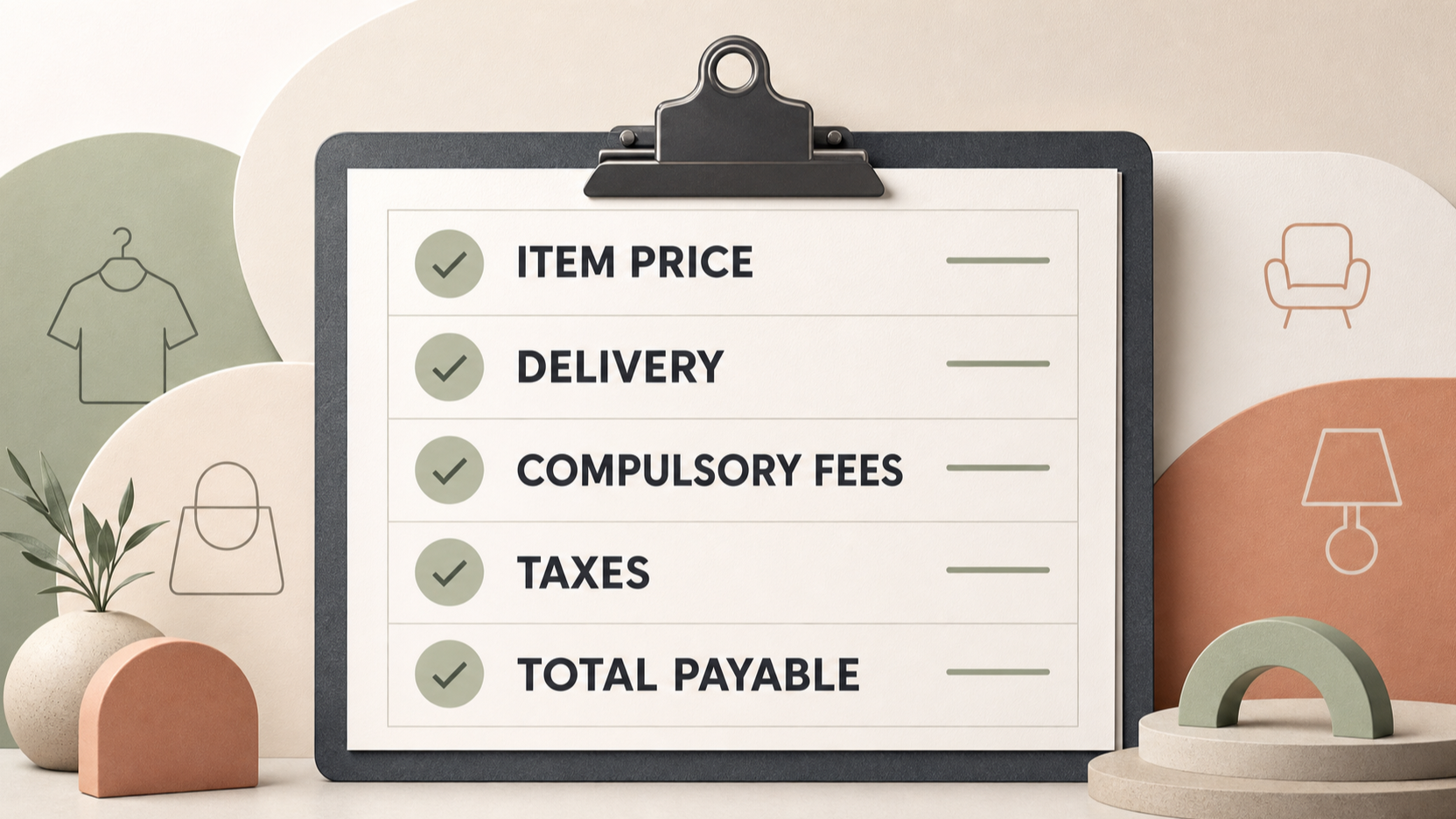 A fashion promotion is not a deal simply because the label shows a reduced price or a large percentage off. Start with the amount that will leave your account if you place the order today. That means the item price plus any delivery charge, compulsory fee, tax or other unavoidable cost shown during checkout.
This is more than a budgeting habit. UK price-transparency guidance says prices should be clear, complete and accurate, and that traders must provide total prices up front, including charges consumers cannot avoid. It also warns against hiding unavoidable fees or taxes until later in the purchase journey. CMA price-transparency guidance
Before deciding that a promotion saves money, pause at the basket and note:
- the item price for the exact size and colour you want;
- delivery or collection costs that cannot be avoided;
- any compulsory charge shown before payment; and
- the final payable total, not just the headline price.
A lower product price can still produce a less useful result than a slightly higher alternative if the final total is higher, or if the cheaper option creates problems you are likely to pay for later. Treat the promotional message as an invitation to check, rather than proof that the purchase represents value.
Test whether the comparison price means anything
A comparison only helps when it compares like with like. “Was” prices, crossed-out prices and percentage reductions can be useful prompts, but they do not answer the practical question: what would it cost to buy an equivalent item on terms that work for you?
Compare the same garment, or the closest genuinely comparable alternative, rather than a broad category. Check the size availability, colour, composition, delivery route and return conditions. A low price on an unavailable size is not a usable saving. Neither is a comparison with an item that has a different fabric mix, a different care burden or a less flexible return route.
The CMA guidance explains why complete price information matters: consumers need it to make informed decisions, shop around and compare competing products. CMA price-transparency guidance Use that principle at shopper level. Put the final payable totals next to each other, then ask whether each option solves the same wardrobe need.
Be cautious where the reference price is vague, old-looking or attached to a product variation that is not the one in your basket. A discount percentage describes the relationship between two stated figures; it does not independently establish that either figure reflects your best available option. If you cannot make a fair comparison quickly, defer the decision or buy only when the item’s usefulness would justify the current total on its own.
Check the return route before buying
AI-generated generic editorial illustration — not a retailer product photo and does not depict the reviewed product or service. Help readers factor the practical return route into the real value of an offer.
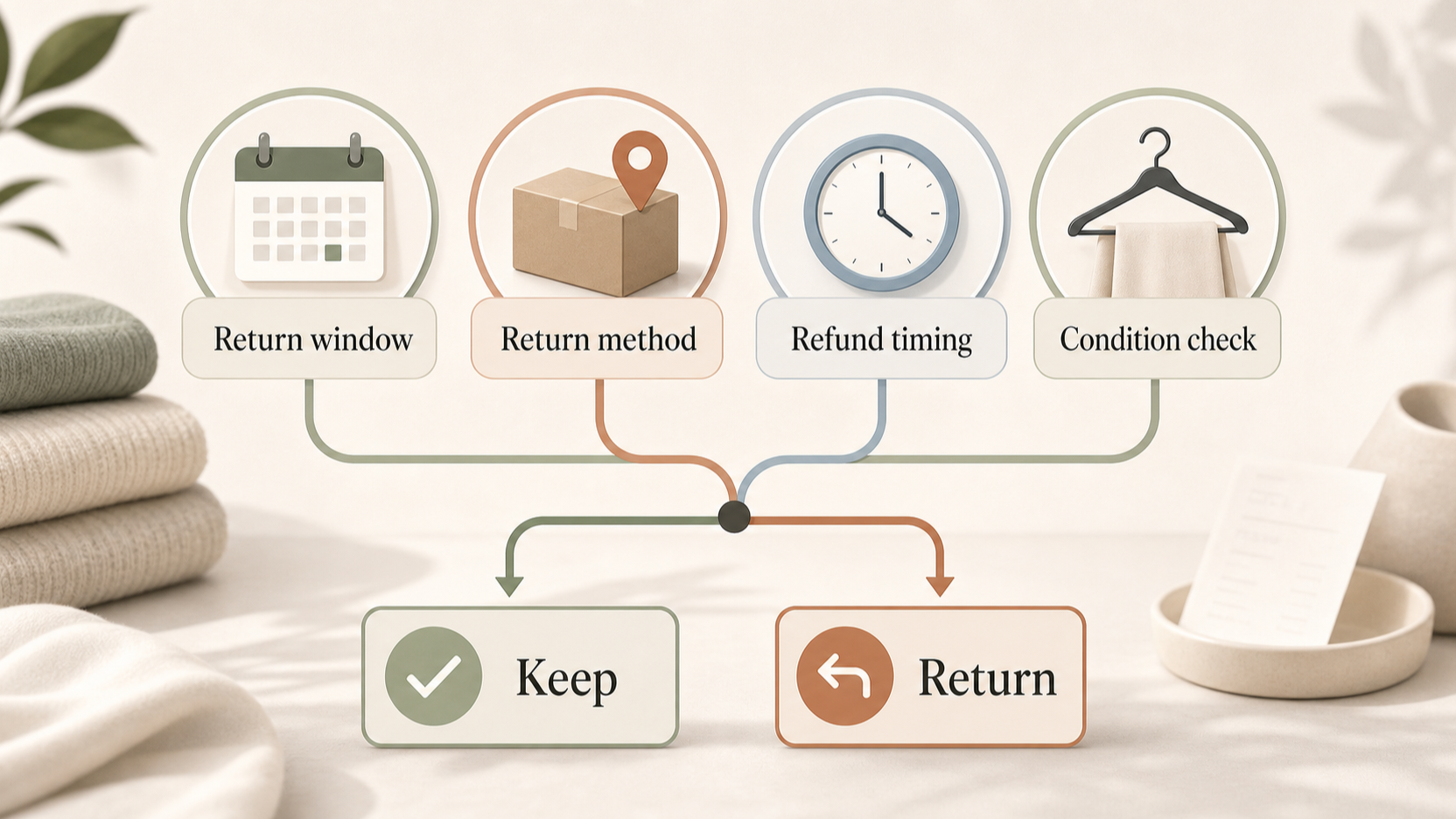 Returns are part of the value calculation, especially for clothing. Fit, feel, colour and suitability are often hard to judge from a product page. A promotion that looks attractive can become poor value if you cannot reasonably undo the purchase when the item does not work for you.
Check the retailer’s current terms before ordering, rather than relying on an old policy summary or an assumption based on another retailer. Look for the return window, the permitted return methods, any condition requirements, whether a cost may apply, and when a refund is expected to be processed. The M&S returns-and-refunds help page directs customers to sign in to make a return or check its status, notes that its policy has changed, and frames refund timing around where the item was returned and when the return is processed. M&S Returns & Refunds
That does not mean every item or order will follow one identical route. It means the live terms are a decision input. If the route is unclear, do not assume that a sale item has the same practical flexibility as a full-price purchase.
A useful pre-buy check is simple: if the garment arrives and the fit, finish or styling is wrong, can you return it within the stated conditions without turning the apparent saving into wasted spend? If the answer is uncertain, allow for that risk in the price you are willing to pay.
Read fabric and care as cost signals
The ticket price is only the beginning of ownership. Fabric and care details can indicate whether a garment fits your normal routine or will demand more time, attention or replacement planning than you expect.
Read the composition and care instructions before buying. Then translate them into ordinary questions: Will you be comfortable wearing it in the situations you have in mind? Can you wash, dry or store it in a way that suits your household? Will you be happy to follow the care requirements often enough for the garment to remain useful?
Avoid treating one fibre as automatically good or bad. The relevant issue is fit with your needs. A garment may be worth the current price if its feel, maintenance and likely role in your wardrobe make sense together. It may be less useful if you would avoid wearing it because the care routine is inconvenient, even if the promotional price is low.
Where the product page leaves you unsure, use the uncertainty as a reason to slow down. Do not convert a missing detail into an optimistic assumption. A clear care label and a realistic plan for using the garment are stronger foundations for value than a dramatic discount badge.
Match the promotion to real use
The best offer is not necessarily the cheapest one; it is the one you are likely to use. Think about the specific occasions, outfits and seasons in which the item would earn wear. If you cannot name a realistic place for it in your existing wardrobe, the promotion may be creating urgency without solving a real need.
Try a short reality check:
- Can you pair it with clothes you already own?
- Would you choose it over alternatives already in your wardrobe?
- Is the fit and care routine compatible with your week?
- Is the item for a repeated need, rather than a one-off imagined occasion?
This approach does not require a precise cost-per-wear calculation. It simply shifts the question from “How much is being taken off?” to “How much useful wear am I likely to get for the total I pay?” An item that works repeatedly can justify a higher current price than a heavily discounted garment that remains unworn.
Be honest about novelty. A promotion can make an optional purchase feel time-sensitive. Give yourself permission to leave it in the basket while you check whether the item still makes sense after the urgency has faded.
Work out the saving after returns care and wear
Bring the checks together before you buy. Start with the final payable total. Test whether the comparison is fair. Confirm that the current return route is workable. Consider the fabric and care demands, then estimate whether the garment will receive enough realistic wear.
The resulting judgement is personal, but the method is repeatable. A promotion is more likely to represent genuine value when the complete current price is acceptable, the comparison is meaningful, and the garment can be used and returned on terms that work for you. The CMA’s guidance supports the first part of that process by requiring complete, upfront price information for unavoidable charges. CMA price-transparency guidance Current retailer returns information supports checking the practical route rather than making assumptions. M&S Returns & Refunds
Use this final checklist:
- Is the final checkout total within my budget?
- Am I comparing equivalent items and terms?
- Have I checked the current return and refund information?
- Can I live with the fabric and care requirements?
- Will I realistically wear it often enough?
If one answer is no or uncertain, the apparent saving may not be a saving for you. Waiting is a valid outcome.
Frequently Asked Questions
Is a large percentage discount enough to prove that a fashion deal is good value?
No. A percentage reduction does not by itself show that the comparison is fair, that the final checkout total is competitive, or that the garment will be useful to you. Compare equivalent items and include unavoidable charges before deciding.
Should delivery charges be included when comparing fashion promotions?
Yes, where they cannot be avoided. UK price-transparency guidance says total prices should be provided up front and should include unavoidable charges, fees and taxes. Compare the final payable total rather than the item price alone. CMA price-transparency guidance
What return details should I check before buying a sale item?
Check the current return window, return method, relevant condition requirements, possible costs and refund timing. Retailer terms can change, so use the live policy for the order you are considering. M&S’s help page, for example, notes policy changes and directs customers to sign in to make a return or check its status. M&S Returns & Refunds
How can I judge whether a fabric will be practical for everyday wear?
Read the composition and care instructions, then relate them to your routine. Consider whether you will be comfortable wearing it, whether you can follow the care requirements, and whether it fits the outfits and occasions you actually have. If a detail is unclear, do not assume it will be convenient simply because the price is reduced.
Related reading
- Next clothing review: sizing, buying conditions and everyday value assessed
- John Lewis fashion review: range, buying guidance and return terms assessed
- How to choose everyday clothing: fit, fabric, care and returns checked in order
- When to buy clothes for better value: need, season, care and return risk compared
Editorial information: About our editorial team · Read our editorial policy · Read our affiliate disclosure.