Choosing everyday clothing is easier when each decision answers one practical question. Start with what the garment needs to do, then check the measurements that matter for that category, consider the care it will require, add up the likely cost of owning it, and confirm the return route before you place the order. This order keeps a familiar size label or an appealing price from doing too much of the decision-making.
The aim is not to find a universally “best” garment. It is to choose one that is useful often enough, manageable enough, and suitable enough for your own week. Retailer size guides and product pages can be valuable evidence, but they are specific to the retailer, the garment category, and sometimes the cut. Treat them as a starting point to check rather than a guarantee of the same fit across every item.
Choose Everyday Clothing in a Consistent Order
Use the same sequence whenever you compare a shirt, pair of jeans, knitwear or outer layer. First, define the job: where will you wear it, what will you wear underneath it, and how often will it need washing? Next, take or confirm the relevant body measurements and compare them with the size guidance for that garment type. Then look at the fibre information and care instructions to decide whether the upkeep fits your routine. Finally, consider the full cost and the return route, including whether the purchase is in store or at a distance.
This sequence is deliberately practical. A garment can look right on a product page yet be a poor everyday choice if it only works with one outfit, needs care you will not realistically do, or cannot be returned through the route you assumed. Equally, a more expensive option is not automatically better value if it is rarely worn.
For a quick reference point, M&S groups men’s size guidance by categories including shirts, jeans, knitwear and outerwear. That is a useful reminder to look for category-specific guidance rather than assuming that one lettered size carries the same meaning across a whole wardrobe. Official M&S size guide
Start With the Job the Garment Must Do
Before opening a size chart, describe the ordinary situations the garment must cover. Is it for commuting, working from home, weekend walking, casual social plans, a smart-casual workplace, or a mixture of these? The answer shapes the level of formality, warmth, room for movement and layering you may need.
Think about the conditions around the garment as well as the garment itself. A lightweight top that works indoors may need space for a base layer or overshirt outdoors. A jacket may need enough room at the shoulders and chest for the knitwear you usually wear beneath it. Trousers may need a length that works with the shoes you reach for most, rather than only with the shoes shown in a product image.
Wash frequency is another useful filter. If an item is likely to be worn repeatedly during a busy week, ask whether you have enough time to wash, dry, press or otherwise care for it between wears. If it will mainly fill a narrow role, be honest about how often that role occurs. This prevents a purchase from being justified by an imagined lifestyle rather than your normal one.
Write down two or three non-negotiables before comparing products. They might be “works with a layer underneath”, “suitable for a weekly wash routine”, or “smart enough for meetings but comfortable for travel”. These checks make later decisions about cut, fabric and price clearer because they are tied to a real use case.
Check Measurements Before You Rely on a Size Label
AI-generated generic editorial illustration — not a retailer product photo and does not depict the reviewed product or service. Make the measurement sequence immediately scannable before readers compare size labels and garment cuts.
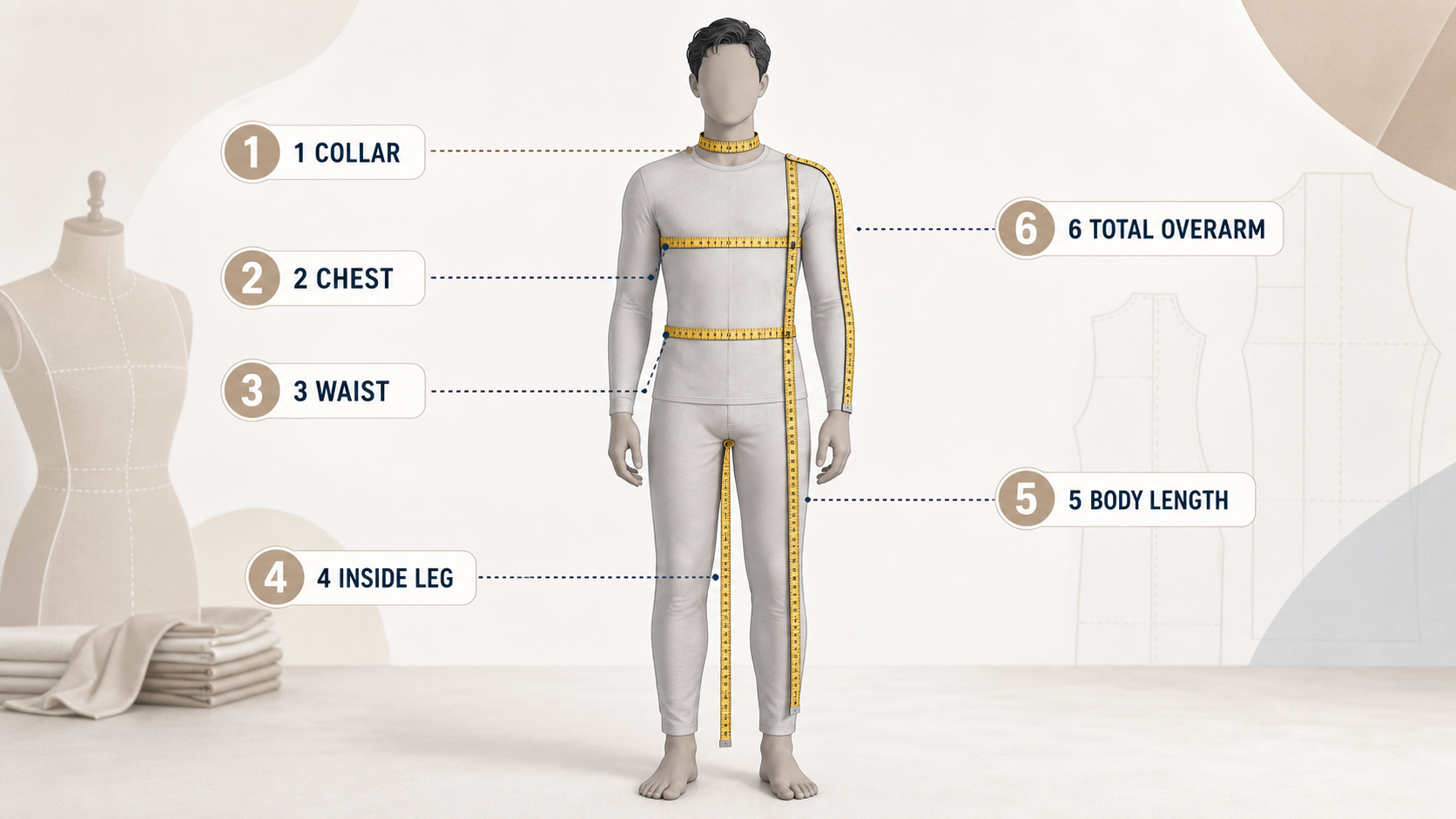 A size label is a shortcut, not a complete fit assessment. Start with your own measurements, then use the retailer’s guidance for the garment category you are considering. M&S’s measuring advice identifies collar, chest, waist, inside leg, body length and total overarm as relevant measurements for different clothing decisions. Official M&S measuring advice
For shirts, measure around the base of the neck where the collar sits, then measure the fullest part of the chest with the tape close under the arms. M&S notes that men’s shirt sizing is determined by neck measurement rather than its standard S, M and L sizing, and that fit can vary by cut and style. That makes the listed neck size useful evidence, but not a reason to skip checking the stated fit or trying the shirt on where possible.
For trousers and jeans, measure the natural waist and take an inside-leg measurement from the crotch to where the trouser would normally sit on the shoe. For jackets or outer layers, body length can help you decide whether a short, medium, long or extra-long option may be relevant. M&S also advises that jacket lengths vary with the garment’s style or fit, so use the length guidance alongside the product description rather than in isolation.
Use the total-overarm measurement only when it is relevant to the garment guidance you are consulting. M&S describes taking it with the arm raised and bent at 90 degrees, measuring from the nape of the neck across the shoulder, down to the elbow and then to the wrist bone. It can provide another point of reference, but it does not replace checking sleeve length, cut and intended layering.
A simple workflow is: measure yourself in consistent conditions, note the figures, open the guide for the specific category, and compare your notes with the options and fit description. If you are between choices, check the product’s cut, available lengths and return route before ordering. Keep a record of the sizes and cuts that have worked for you, but revisit the guidance when moving between categories or brands.
Editorial asset placement — measurement workflow: use the approved disclosed diagram showing collar, chest, waist, inside leg, body length and total overarm.
Treat Fabric and Care as Everyday Trade-Offs
Fabric names alone do not decide whether an item will suit your routine. Read the fibre content and the care label together, then relate them to how you expect to use the garment. The useful question is not whether one fibre is inherently superior; it is whether the garment’s feel, construction and maintenance requirements match the role you identified.
Start with the care instructions. Check the wash method, temperature, drying instructions, ironing guidance and any specialist-cleaning requirement before buying. Consider whether you have the equipment, time and storage space to follow those instructions. A garment that needs gentler handling may still be a good choice, but its care burden should be part of the comparison rather than an afterthought.
Then consider layering and day-to-day comfort in context. Look at the garment’s weight, lining, shape and the space it leaves for other layers. A close-fitting knit may work differently over a shirt than over a T-shirt; an outer layer may feel different with a jumper beneath it. Product descriptions and care labels can help you form questions, but they cannot fully predict your individual comfort or how a particular cut will sit on you.
Durability is also best treated as a practical question. Examine construction details available on the page, think about where the garment will experience wear, and decide whether you can realistically give it the care it asks for. Avoid assuming that a higher price, a particular fibre, or a familiar label guarantees a longer useful life.
Check Total Cost and the Return Route Before You Buy
The price at checkout is only one part of value. Compare the purchase price with the number of likely wears, the care effort, and the chance that alterations or replacement will be needed if the fit or role is wrong. This does not produce a precise universal figure, but it makes the trade-off visible: a cheaper garment that remains unworn is poor value, while a higher-priced item still needs to earn its place through regular, suitable use.
Before ordering, identify the purchase route and read the retailer’s current terms for the item. Check return exclusions, the required condition of the garment, any deadlines, fees, and the steps for starting a return. These retailer terms sit alongside, rather than replace, statutory rights.
For UK purchases made online, by mail or by phone, GOV.UK states that customers have a limited right to cancel even when the item is not faulty. Where the distance-selling cancellation timetable applies, the customer must tell the seller within 14 days of receiving the item that they want to cancel, then has another 14 days to return it. The seller must refund within 14 days of receiving the item back, and the standard delivery cost must also be refunded; a premium delivery upgrade need only be refunded at the standard-delivery rate. GOV.UK guidance on returns and refunds
That guidance is not a substitute for checking the particular transaction and item. GOV.UK also identifies situations and categories where the rules differ, and in-store purchases have different change-of-mind treatment. If an item is faulty, not as described or does not do what it is supposed to do, consumer rights may apply; do not rely on a retailer statement that appears to remove those rights. GOV.UK guidance on returns and refunds
Frequently Asked Questions
Should I buy my usual size if the brand provides a size guide?
Use your usual size as a starting point, not the final answer. Compare your current body measurements with the guide for the specific garment category and read the fit description. M&S’s guidance, for example, says men’s shirt sizing is based on neck measurement and that fit can vary by cut and style. If you are between options, consider the intended layering and check the return route before committing. Official M&S size guide
Can I return online clothing in the UK if I simply change my mind?
For online, mail and telephone purchases, GOV.UK says customers have a limited cancellation right even if an item is not faulty. The supplied guidance describes a 14-day notification period after receipt and a further 14 days to return the item, subject to the applicable rules and exceptions. Check the retailer’s current process and the item’s terms before ordering. GOV.UK guidance on returns and refunds
What should I check on a care label before buying everyday clothing?
Check how the item should be washed, dried and ironed, plus any instruction that would require time, equipment or specialist cleaning. Then decide whether that routine suits how often you expect to wear it. Care information does not tell you everything about comfort or longevity, but it is an important part of judging whether the garment is workable day to day.
Is a lower-priced garment always better value for an everyday wardrobe?
No. Consider the likely number of wears, whether the item works with your existing clothes, the care it requires, and the risk that poor fit will leave it unused. A lower initial price can be attractive, but it should be weighed against whether the garment will actually perform the job you chose it for.
Related reading
- Best UK high-street brands for wardrobe essentials: evidence-led top choices
- Marks & Spencer vs Uniqlo: which is better for everyday wardrobe basics?
- Uniqlo UK clothing review: who it suits and where the trade-offs sit
- How everyday clothes should fit, feel and perform before you decide to keep them
Editorial information: About our editorial team · Read our editorial policy · Read our affiliate disclosure.