Buying clothes at a better value is less about finding the biggest percentage off and more about making a purchase that earns its place in your wardrobe. Use this guide to compare need, total cost, likely wear, care demands and the downside if the item does not work out.
What Practical Clothing Value Means
Practical value starts with what the garment will do in your real life. A lower-priced top that stays unworn can be poor value, while a more expensive layer that fills a frequent gap may be the more useful choice. The aim is not to make every purchase perfect or to turn getting dressed into a spreadsheet. It is to pause long enough to separate a helpful addition from a tempting extra.
Before looking at a promotion, ask whether you already own something that serves the same purpose. Think about the occasions you actually dress for: commuting, relaxed weekends, work, exercise, events or changing weather. A piece that works with several existing items has a clearer route into regular use than one that requires new shoes, special underwear or a different version of yourself.
Value also includes ease. If an item is comfortable, suits your routine and can be worn in more than one setting, it is easier to reach for again. That is usually more meaningful than a dramatic sale label. Build your decision around usefulness first; price is then a comparison tool, not the whole argument for buying.
Start With Need and Likely Wear
Use a short need test before opening more tabs. What gap would this item fill this month? Can you name at least three likely occasions to wear it? Which pieces already in your wardrobe would you combine it with? If the answers are vague, put the item on a wish list and revisit it after a few days.
A near-term need can be straightforward: replacing worn-out trousers, adding a weather-appropriate layer, or finding something for a confirmed occasion. A less urgent purchase can still be worthwhile, but it deserves more scrutiny. Ask whether the attraction is the garment itself or the feeling created by a countdown, limited stock message or discount code.
Likely wear matters more than an imagined best-case life. Consider your usual climate, dress code, laundry rhythm and comfort preferences. A striking item for rare occasions may be a deliberate treat, but it should not be judged by the same value test as a dependable everyday knit. Be honest about the role it is likely to play, then set a spend that fits that role.
Compare the Complete Price Not the Discount
AI-generated generic editorial illustration — not a retailer product photo and does not depict the reviewed product or service. Reinforce that shoppers should compare the complete payable price rather than the headline discount.
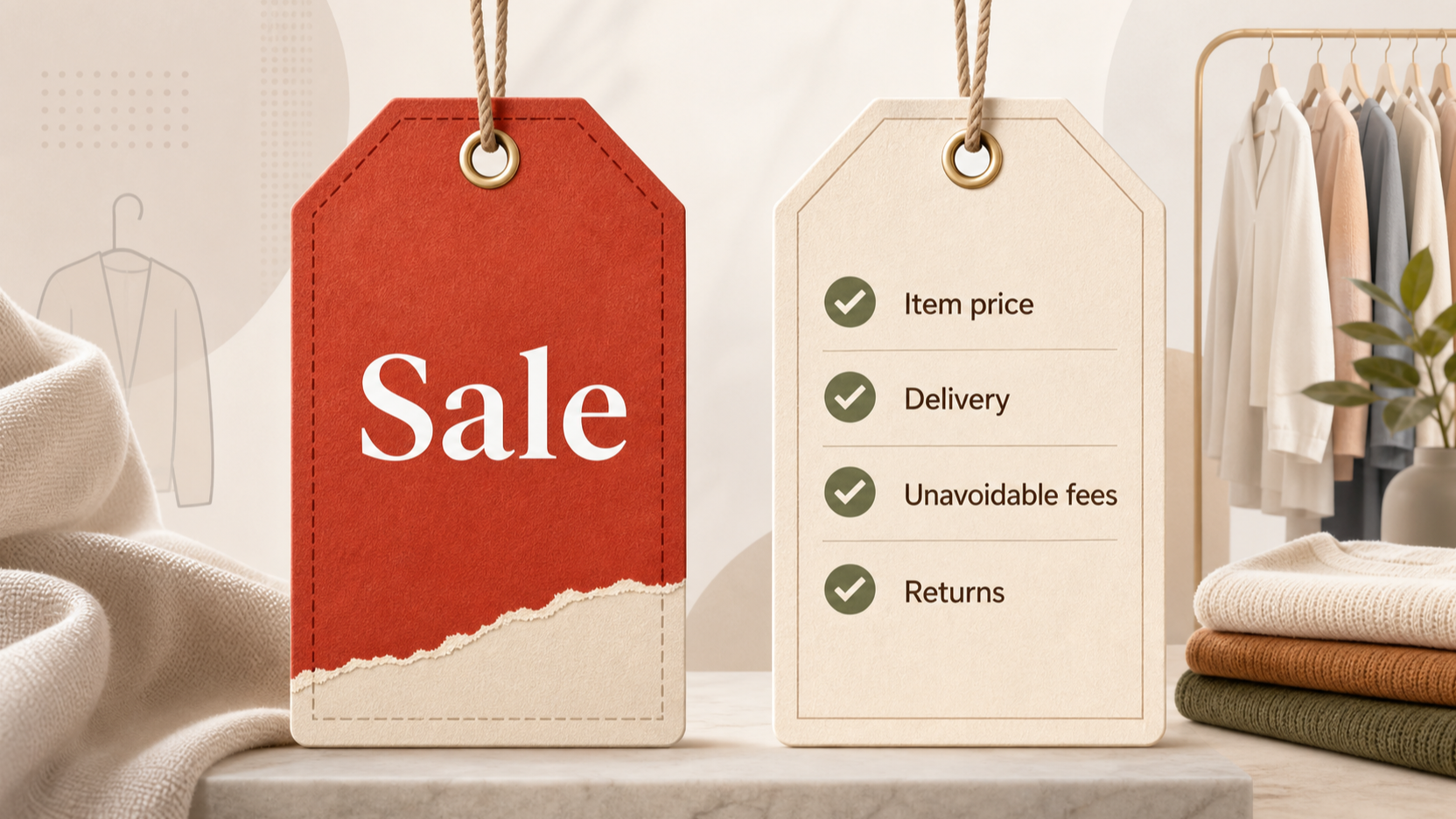 A sale price is only one number. Compare the amount you will actually pay: the item, delivery option, any unavoidable charges and any cost you could face if a return becomes necessary. A cheaper item from one retailer may stop being cheaper once the checkout total and ownership friction are included.
UK price-transparency guidance says consumers should receive clear, complete and accurate pricing, including unavoidable charges, up front. That helps shoppers compare offers on a like-for-like basis; it is also a useful personal checkout rule. If the final total changes your view of the purchase, the discount was not the relevant comparison.
Try a simple side-by-side check before paying:
- Record the final checkout total, not just the displayed item price.
- Compare equivalent delivery speeds rather than selecting a premium option in one basket and standard delivery in another.
- Check whether a free-delivery threshold encourages you to add an item you would not otherwise buy.
- Read the return terms before treating a low headline price as a low-risk choice.
Do not assume that a higher initial price is automatically worse value. A transparent total, a more suitable fabric and a manageable return process can make an option easier to live with. Equally, do not use a complicated calculation to justify something you do not need. The complete-price check is there to clarify the decision, not to manufacture one.
Estimate Wear Before Paying More
Cost per wear can be a helpful thought exercise, not a promise. Divide the complete purchase cost by a conservative estimate of realistic wears. The useful word is conservative: count the times you expect to choose the garment in your actual routine, rather than the number you hope it will be worn.
For example, an everyday coat may have many likely opportunities across a cold season, whereas a delicate party top may have fewer. Neither choice is automatically right or wrong. The question is whether the planned spend matches the role. If a garment needs a special occasion, extra purchases or a major change in habits before it gets worn, use a lower wear estimate.
Repeat wear usually improves when the item works with what you own already. Try a quick outfit test: pair it with three existing bottoms, layers or shoes. If you can make those combinations easily, the item has a stronger chance of becoming useful. If every outfit depends on a future purchase, include that dependency in your decision.
Account for Fabric and Care Burden
Read the fibre content and care label before treating a garment as a bargain. The question is not whether one fabric is universally better; it is whether the material and upkeep suit your priorities. A fabric you enjoy wearing but avoid washing or storing may create more friction than its ticket price suggests.
Consider how the item fits your normal routine. Does it need specialist cleaning, hand washing, delicate drying, frequent ironing or separate storage? Will it work in the temperatures you actually experience? Is the fabric likely to feel comfortable for the length of time you expect to wear it? These are practical questions, especially for everyday pieces.
Care can also affect how confidently you wear something. A pale, delicate garment may be ideal for occasional use but less convenient for crowded commutes or family weekends. A washable layer may earn more use even if it is not the most exciting option in the fitting room. Match the care burden to the role you expect the garment to play.
When comparing two similar items, write down the difference in care rather than relying on an impression. Choose the option whose upkeep you are genuinely willing to do. That keeps the decision focused on ownership, not just the moment of checkout.
Check Return Risk Before You Commit
AI-generated generic editorial illustration — not a retailer product photo and does not depict the reviewed product or service. Give readers a quick visual sequence for weighing use, ownership friction, and return risk before buying.
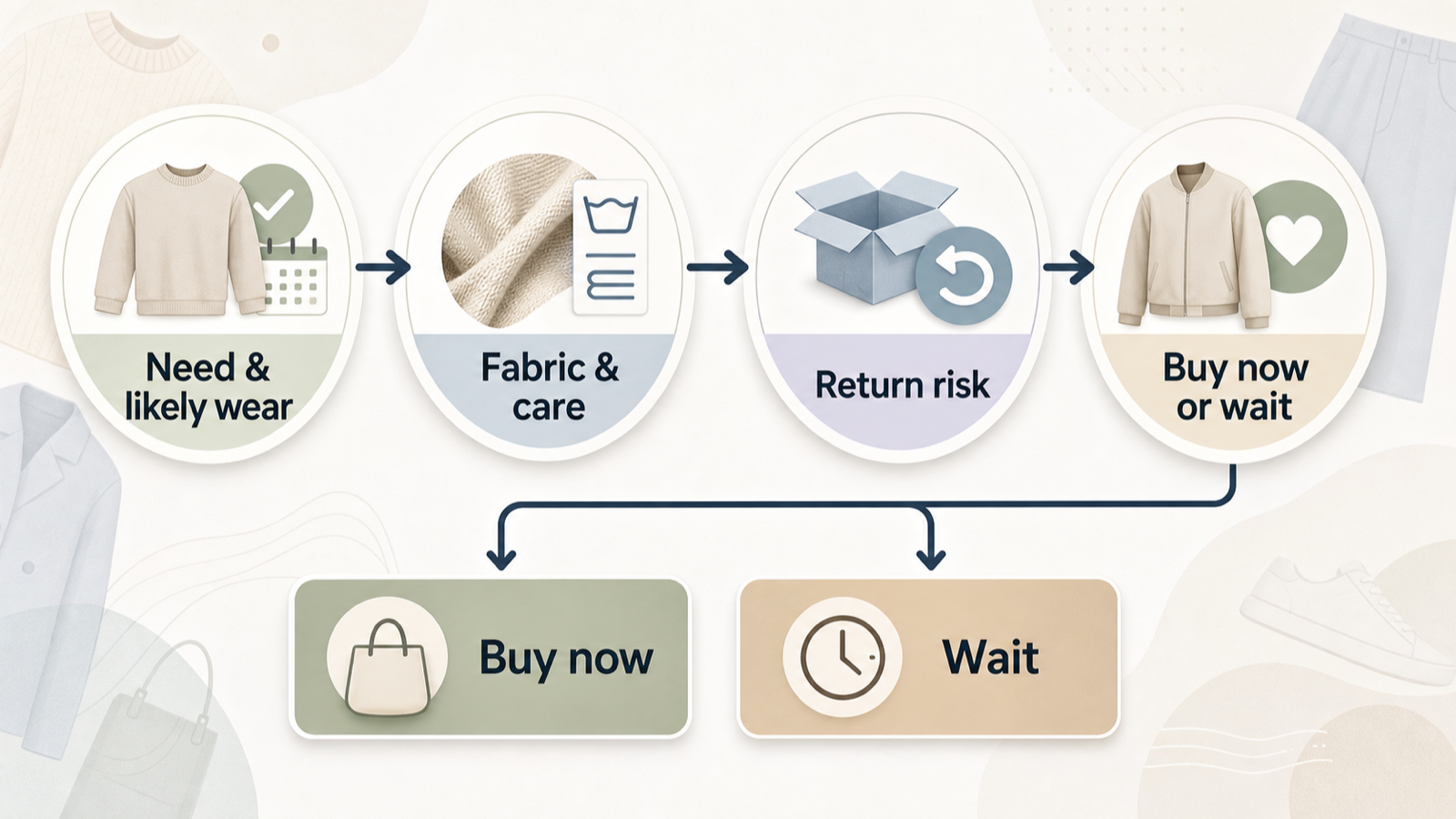 Online clothing purchases carry extra uncertainty: fit, colour, weight, texture and proportion can be difficult to judge from a screen. Reduce that risk before ordering. Check the size guide against a garment you already own, look for fabric composition and care details, and read whether the retailer requires tags or hygiene seals to remain intact.
For distance sales in the UK, GOV.UK explains that customers generally have a limited right to cancel an online, mail or telephone order even when the item is not faulty: they must tell the seller within 14 days of receiving it, then normally have another 14 days to send it back. The official guidance also describes exceptions and condition-related limits, so use it as a starting point rather than assuming every item is handled identically.
A retailer's voluntary returns policy may be more generous than the legal baseline, but it is not the same thing as statutory consumer rights. GOV.UK also states that faulty, misdescribed or unsuitable goods can trigger refund rights. For a purchase where the terms are unclear, read the retailer's policy and the official guidance before you commit; do not rely on a checkout badge or an old social-media tip.
Make the risk concrete. Who pays return postage? Is there a short return window? Can you realistically try the item on and send it back promptly? Is the product in a category with restrictions? A low price is less attractive if returning a poor fit would be expensive, inconvenient or impossible for you. If the answer is uncertain, wait until you have the information or choose a lower-risk option.
Choose the Right Time to Buy
The right time to buy is when need, usable season and risk line up. A seasonal sale can be useful when the item will still fit into your wardrobe soon, you know your size in that retailer, and the complete price makes sense. It is less persuasive when the purchase is only attractive because the discount is ending.
End-of-season shopping works best for dependable categories with a clear future use: a replacement coat for next winter, school basics in a known size range, or a staple colour you already wear often. It is weaker for trend-led pieces, items with uncertain sizing or garments that may sit unused until your needs change.
Give yourself a waiting option. Save the item, check your wardrobe, and return after a day or two. If you still see a specific role for it, compare the complete price and return conditions again. If the appeal fades, you have avoided spending simply because a promotion created urgency.
For genuinely urgent needs, decide a budget and a minimum specification before browsing. That makes it easier to choose a workable item without being pulled into upgrades that solve a different problem. Buying now, waiting and skipping are all valid outcomes when the decision is based on use rather than pressure.
Frequently Asked Questions
Is a sale item good value if I do not need it yet?
Possibly, but the discount alone does not make it good value. Check whether it has a clear future role, works with clothes you own and is likely to be worn when its season arrives. If you cannot name those uses, waiting protects your budget and leaves room for a more useful purchase later.
Should I buy winter clothes at the end of the season?
Buy only if the item is a dependable category you expect to use next winter, the fit and care are acceptable, and the complete price is within your planned spend. Be more cautious with trend-driven items, uncertain sizes and purchases that would be difficult to return after a delayed try-on.
What should I check about returns before buying clothes online?
Read the retailer's return window, item-condition rules, exclusions and return-postage terms. For the UK baseline on distance-sales cancellation rights and exceptions, consult the official GOV.UK guidance before relying on a retailer summary. Keep the order confirmation and act promptly if you decide the item is unsuitable.
Does a higher price always mean better value?
No. A higher price can be justified only when it matches a real need and a realistic pattern of wear, while the fabric, care and return risk remain acceptable. Compare the complete cost and the role the item will play rather than assuming either the cheapest or most expensive option is automatically smarter.
Before your next checkout, use this sequence: need, complete price, likely wear, care burden and return risk. If the purchase still makes sense after each step, you have a stronger reason to buy than a discount alone.
Sources: GOV.UK guidance on clear and accurate prices and GOV.UK guidance on returns and refunds.
Related reading
- Next clothing review: sizing, buying conditions and everyday value assessed
- John Lewis fashion review: range, buying guidance and return terms assessed
- How everyday clothes should fit, feel and perform before you decide to keep them
- How to identify genuine fashion deals: price, returns, fabric and use checked together
Editorial information: About our editorial team · Read our editorial policy · Read our affiliate disclosure.